Diana Ragbir-Shripat, PhD Department of Computing and Information Technology The University of the West Indies, St. Augustine
The process behind the product
Pathways, branches, and revision.
Illustrative process map. Process evidence and the resulting product can be considered together.
Current funded research
Muse 2.0
Making learning-process representation computational, and validating it.
Funding
UWI CR&P
Approved
26 May 2026
Planned duration
11 months
Muse 2.0 extends earlier creativity-support research toward a configurable framework for representing and supporting learning processes computationally.
The current phase focuses on making the learning-process representation computational and validating it. We are currently exploring ontologies as a way to formalize this representation and its relationships.
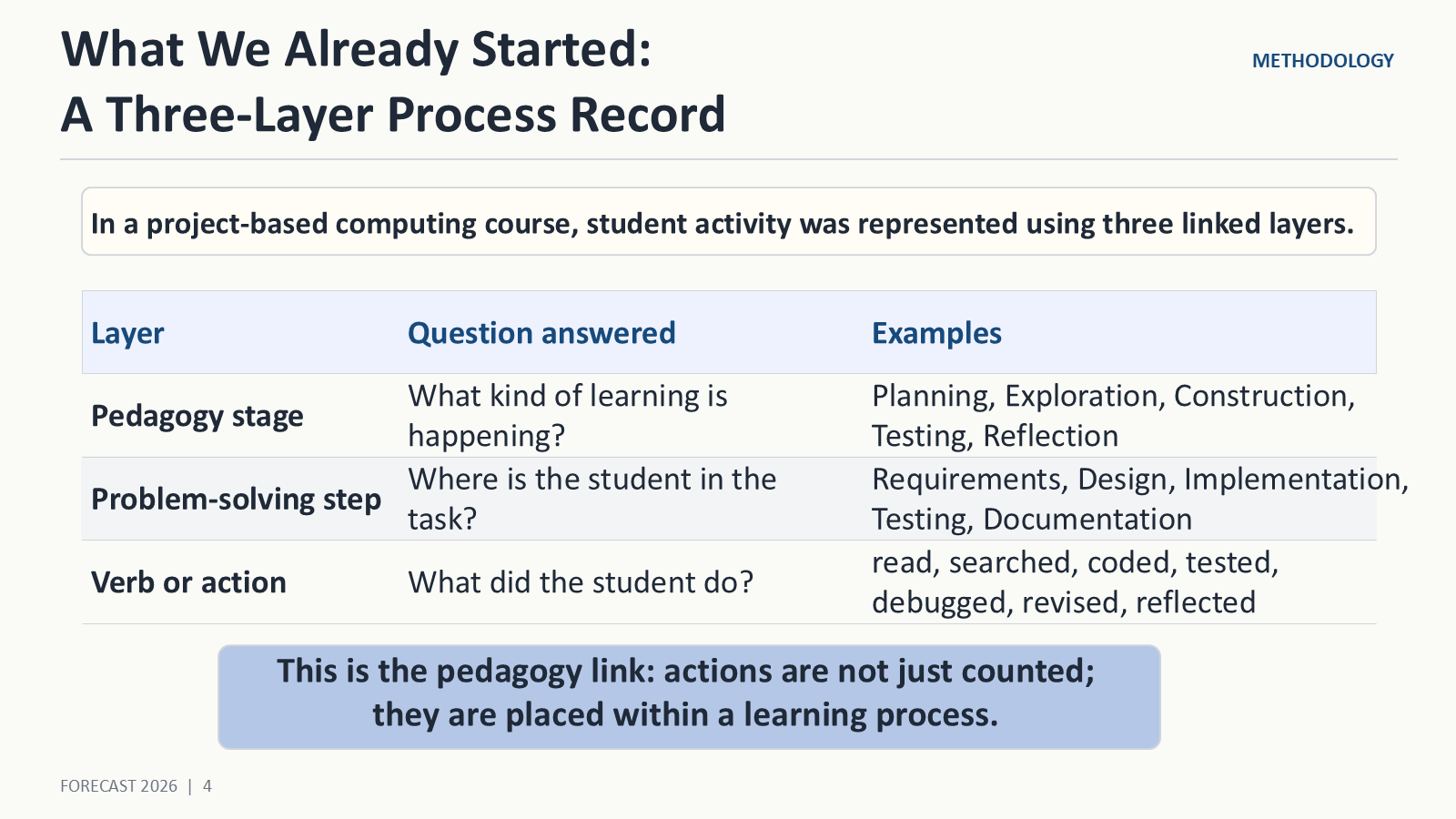
A four-layer framework of pedagogical stages, problem-solving steps, activities, and verbs
Assessment-specific configuration that maps captured activity within the pedagogical process the assessment is designed to support
Validation of the representation, including its concepts, relationships, and interpretation
Lecturer configuration. A formal process representation.
Structuring captured activity within the pedagogical process an assessment is designed to support.
The emerging application is intended to let lecturers configure pedagogical stages, assessment-specific problem-solving steps, activities, verbs, transitions, and relevant objects or concepts. We are exploring ontology generation as a way to make this representation computational and open to validation. The workflow below describes the research direction, including later pilot and analytics stages.
Enacted representationEvidence of student activity
Intended vs enactedCompare pathways in context
Educational interpretationAssessing process and product together
An invitation to researchers and educators
Help shape the next phase.
Bring your expertise, an assessment, or a course context. These are opportunities to collaborate on emerging research.
Expert perspectives
Validate the Learning-Process Ontology
Review definitions, conceptual completeness, relationships, competency questions, and representative scenarios. Help identify ambiguity and consider transfer across disciplines.
For researchers in learning analytics, pedagogy, assessment, computing education, or semantic technologies. No ontology-building required.
Discuss using the emerging prototype to describe pedagogical stages, problem-solving steps, activities, verbs, and transitions. Review whether the proposed representation reflects your assessment.
A prospective study of configuration usability and ontology generation, subject to prototype readiness.
Start with one suitable assessment. Identify meaningful traces from existing tools, minimize additional logging, and investigate what process evidence lecturers find useful.
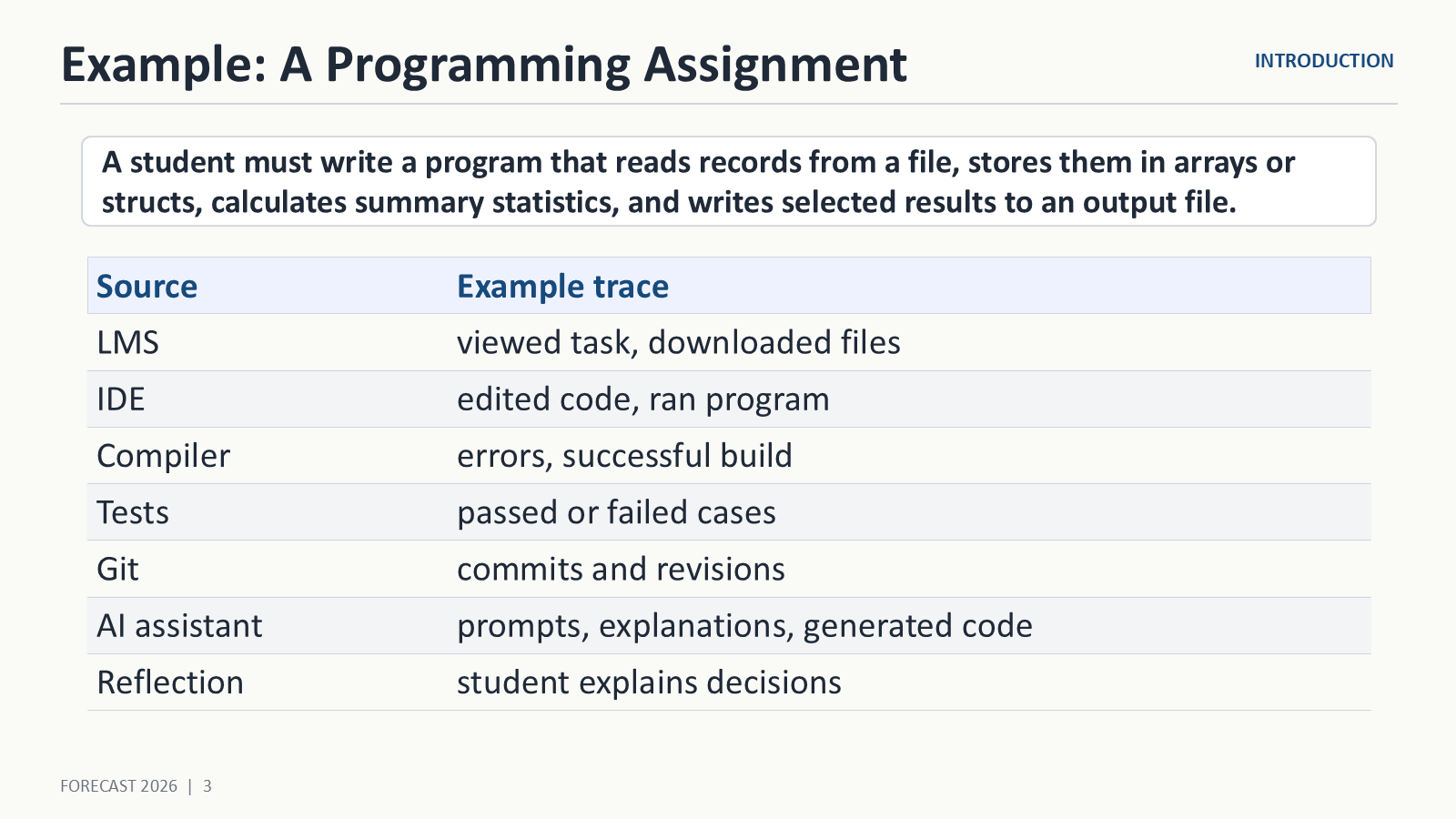
Plan data collection with appropriate ethics approval. Potential sources include LMS, IDE, Git, tests, reflections, and AI-use declarations.
Cross-institutional and cross-disciplinary conversations are welcome, including assessment contexts in which generative AI use is permitted.
Why this matters
Assessing process and product together.
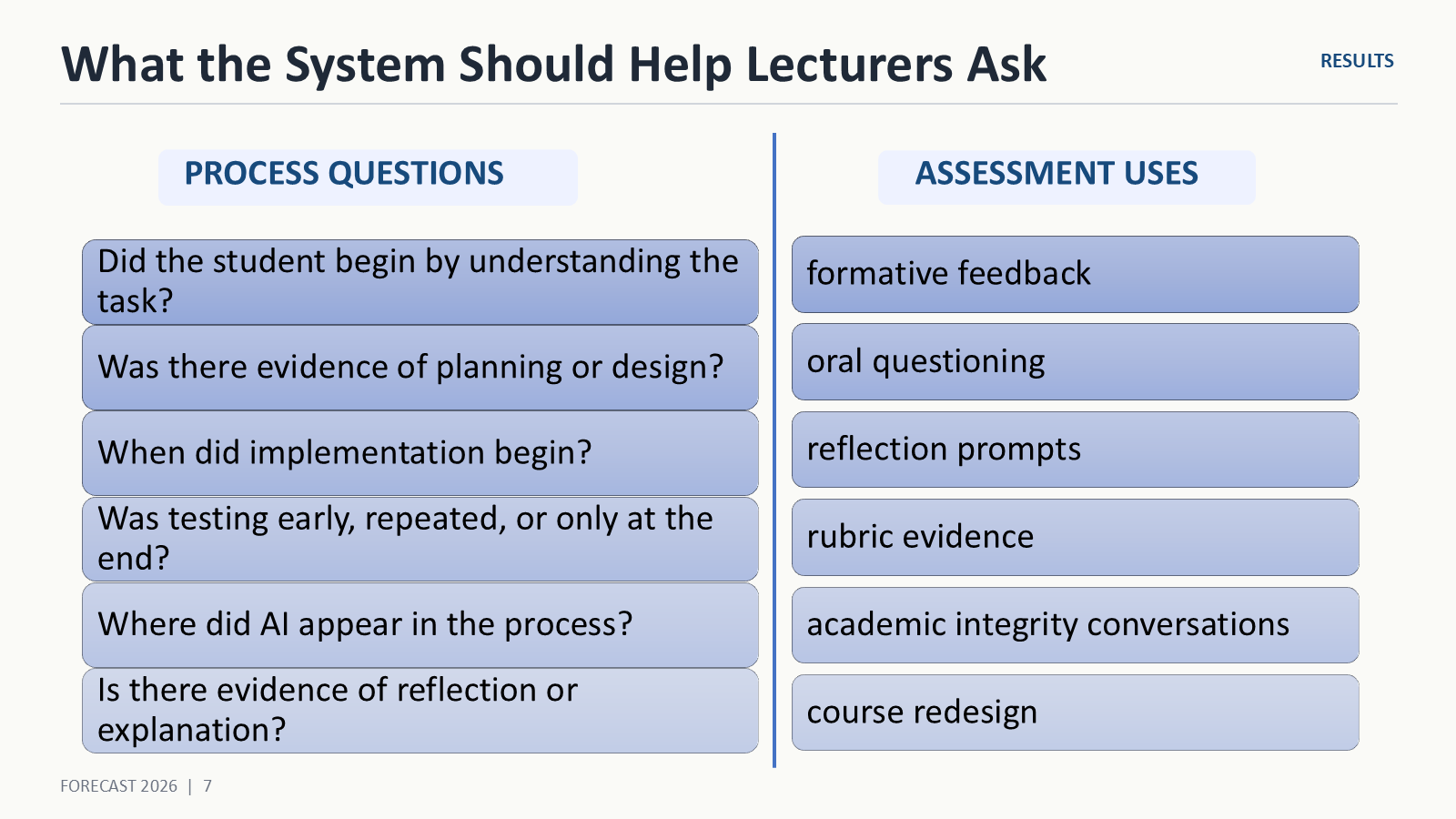
How did the learner explore, make decisions, test ideas, and use AI along the way?
With generative AI, a final product alone may no longer reliably represent a student's learning. The research direction is to support assessment of both the process and the product together, so lecturers can consider how work developed alongside what was produced.
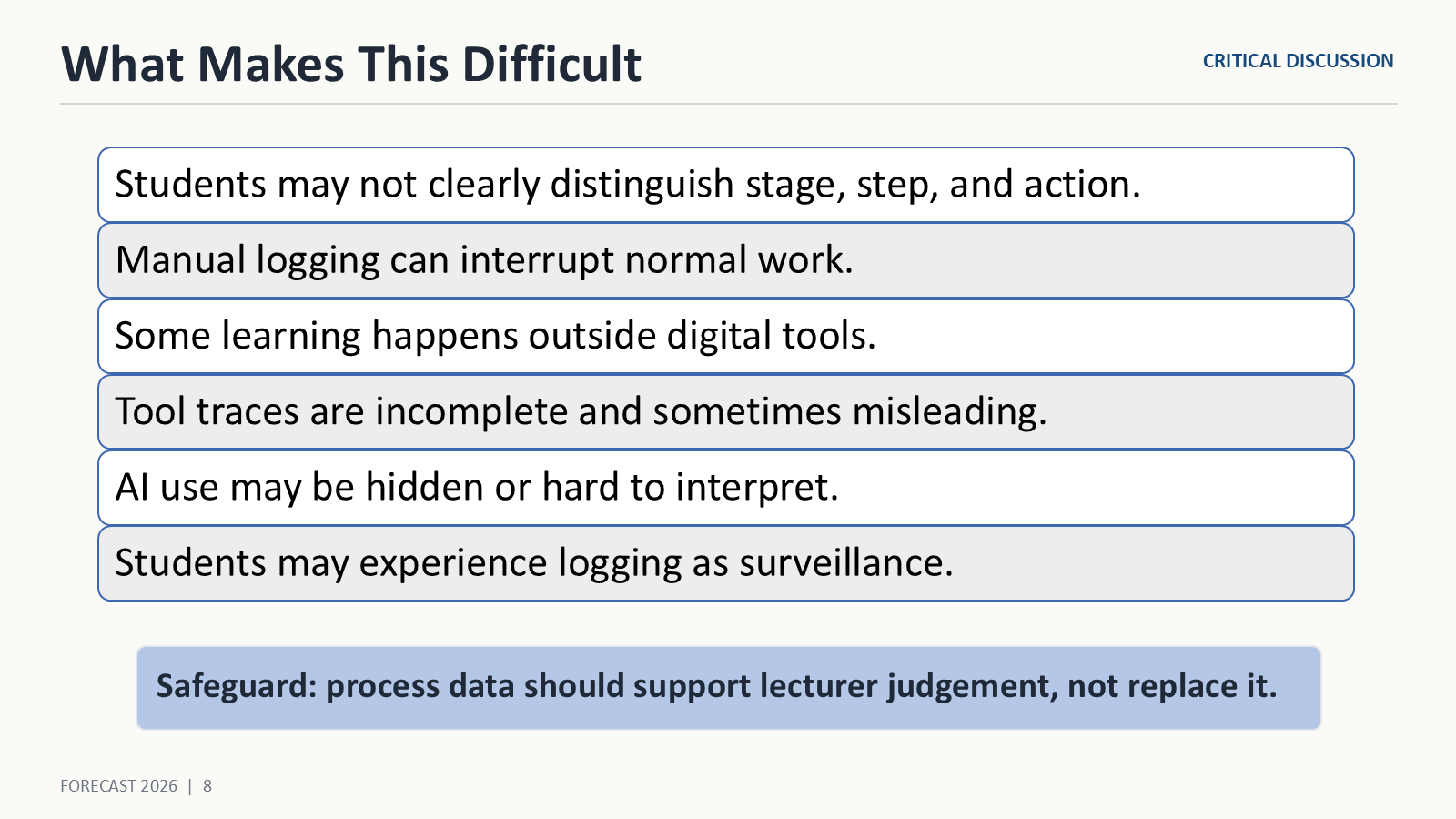
This requires more than collecting digital traces. Captured activities need to be structured and mapped within the pedagogical process the assessment is designed for. The aim is to support lecturer judgement about learning through process and product evidence together. Such evidence does not, by itself, prove authorship or directly measure learning.
The broader research programme
Computational representation of learning processes.
A programme developing from guided creativity toward computational learning-process representation, validation, analytics, and assessment of process and product together. The connections below show related strands, rather than a strict chronological dependency.
Original MuseGuided creativity in novice Scratch programming. Creative Process and creative Product remain distinct.
Learning-Process RepresentationPedagogical stages, problem-solving steps, activities, and verbs, with captured activity mapped within the assessment's pedagogical process.
xAPIA technical mechanism for structured events, distinct from conceptual meaning.
Learning-Process OntologyEmerging formal concepts and relationships, with structural and expert evaluation.
Muse 2.0Making the representation computational and validating it, with ontologies currently being explored.
AI ClassificationInvestigating classification of activity and the potential to reduce manual burden.
Process AnalyticsFuture pathway, sequence, and transition analysis where data support it.
Process-Aware Learning Design and AssessmentConsidering process and product together to support lecturer judgement in the generative AI era.
A central research distinction
Intended and enacted.
Intended Learning Process
The pedagogical process the assessment is designed to support, including its stages, problem-solving steps, activities, and transitions.
Compare in context
Enacted Learning Process
The process a learner actually follows, represented through available evidence of activity.
Divergence may be productive. Exact matching is not the goal. Comparison may reveal learning-design insights, feedback opportunities, assessment evidence, and questions for research analytics.
From events to educational meaning
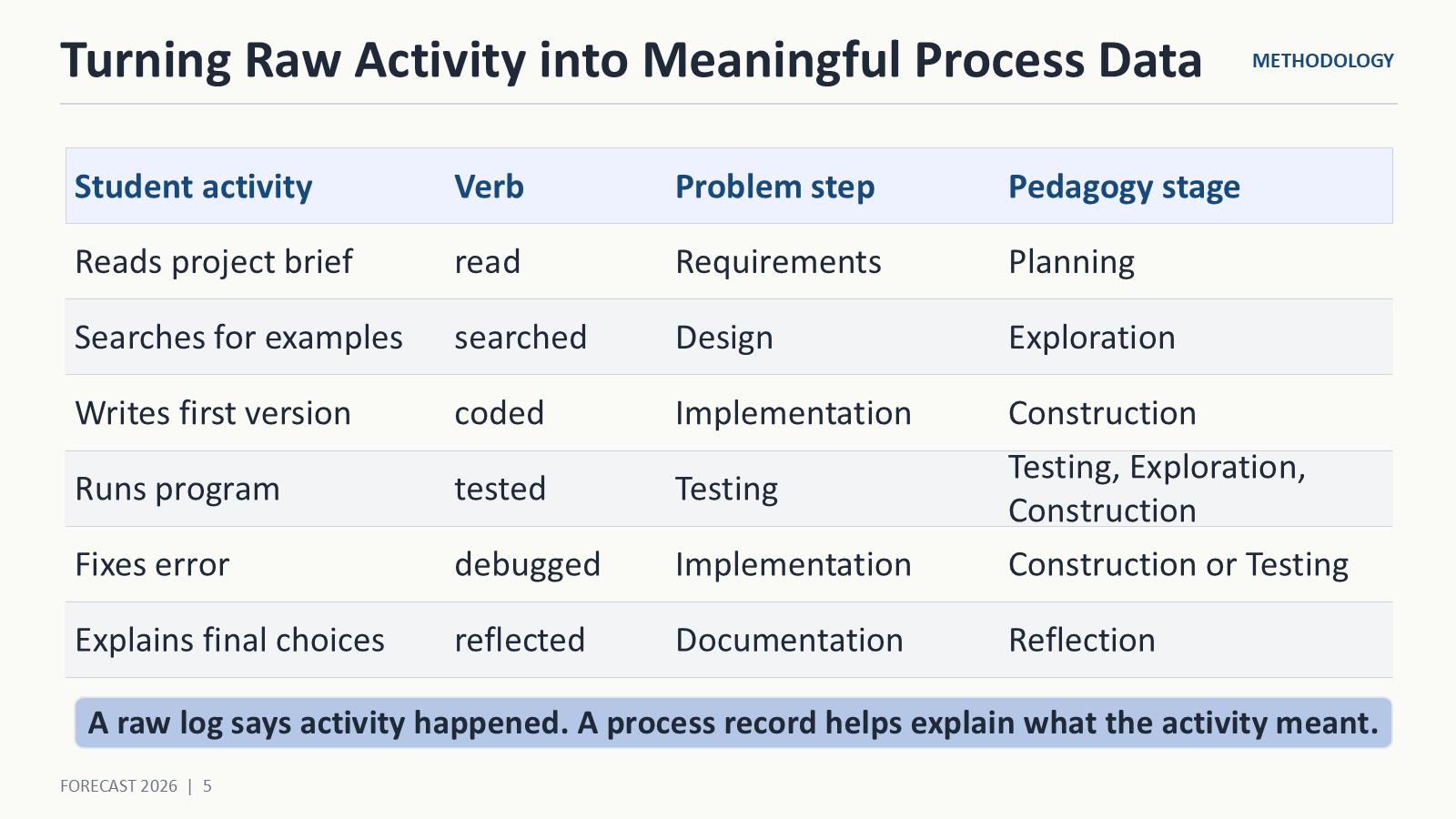
What does “ran the program” mean?
It could be exploration, testing a partial solution, validating a completed solution, or diagnosing an error. Interpretation needs context.
Raw event
Learning-Process Representation
Structured process data
Process analytics
Educational interpretation
Conceptual representation, serialization, classification, and analytics are distinct research problems. An action verb alone is insufficient.
Featured research outputs
Recent work. Next questions.
IEEE TALE 2026
Beyond the Final Artifact: A Stage-Aware Framework for Process Evidence in AI-Influenced Computing Assessment
Accepted IEEE TALE 2026 short paper
A framework contextualizing process records through engagement stage, assessment-specific problem-solving step, action verb, and action object. xAPI is an implementation mechanism.
Review by 3 computing educators used 12 representative scenarios, producing 36 expert-scenario classifications. This provides preliminary evidence of interpretability, rather than generalizable validation.
Expert-review findings
Stage and step classification agreement
Measure
Stage
Step
Majority agreement
91.7%
100%
Pairwise agreement
69.4%
83.3%
Fleiss' kappa
0.59
0.78
Mean classification confidence was 4.53 / 5.
FORECAST 2026
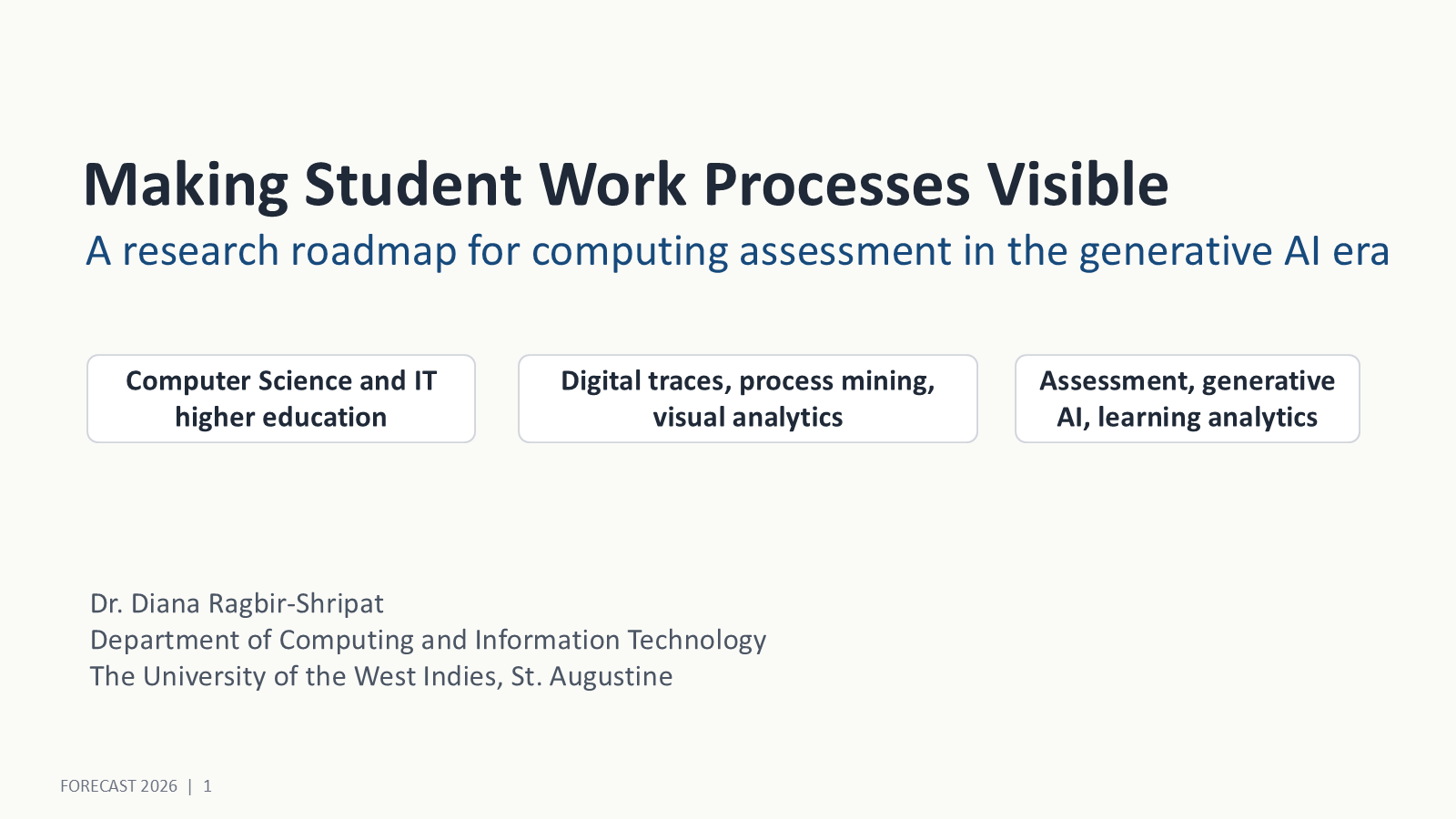
Making Student Work Processes Visible
A research roadmap for computing assessment in the generative AI era
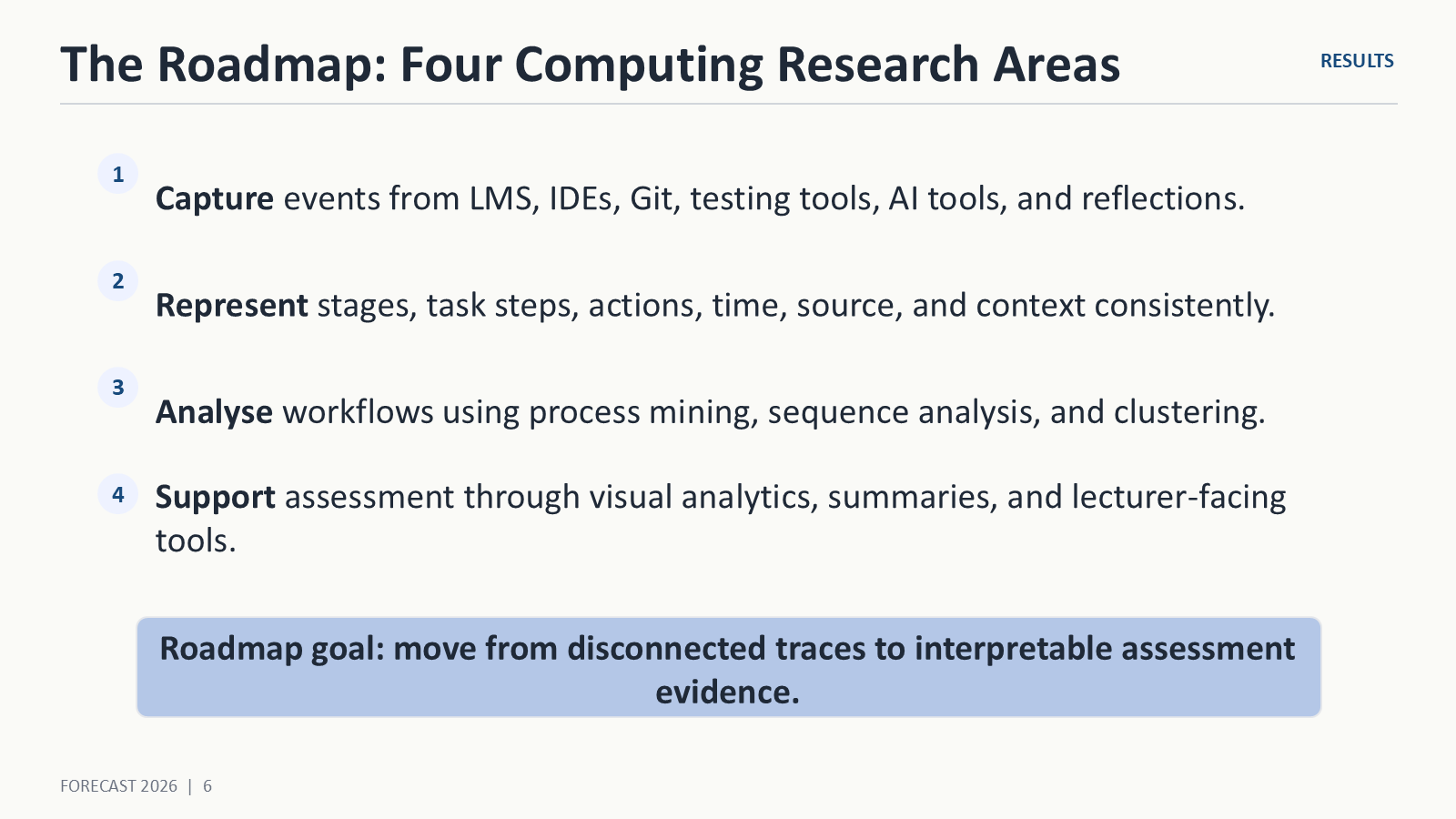
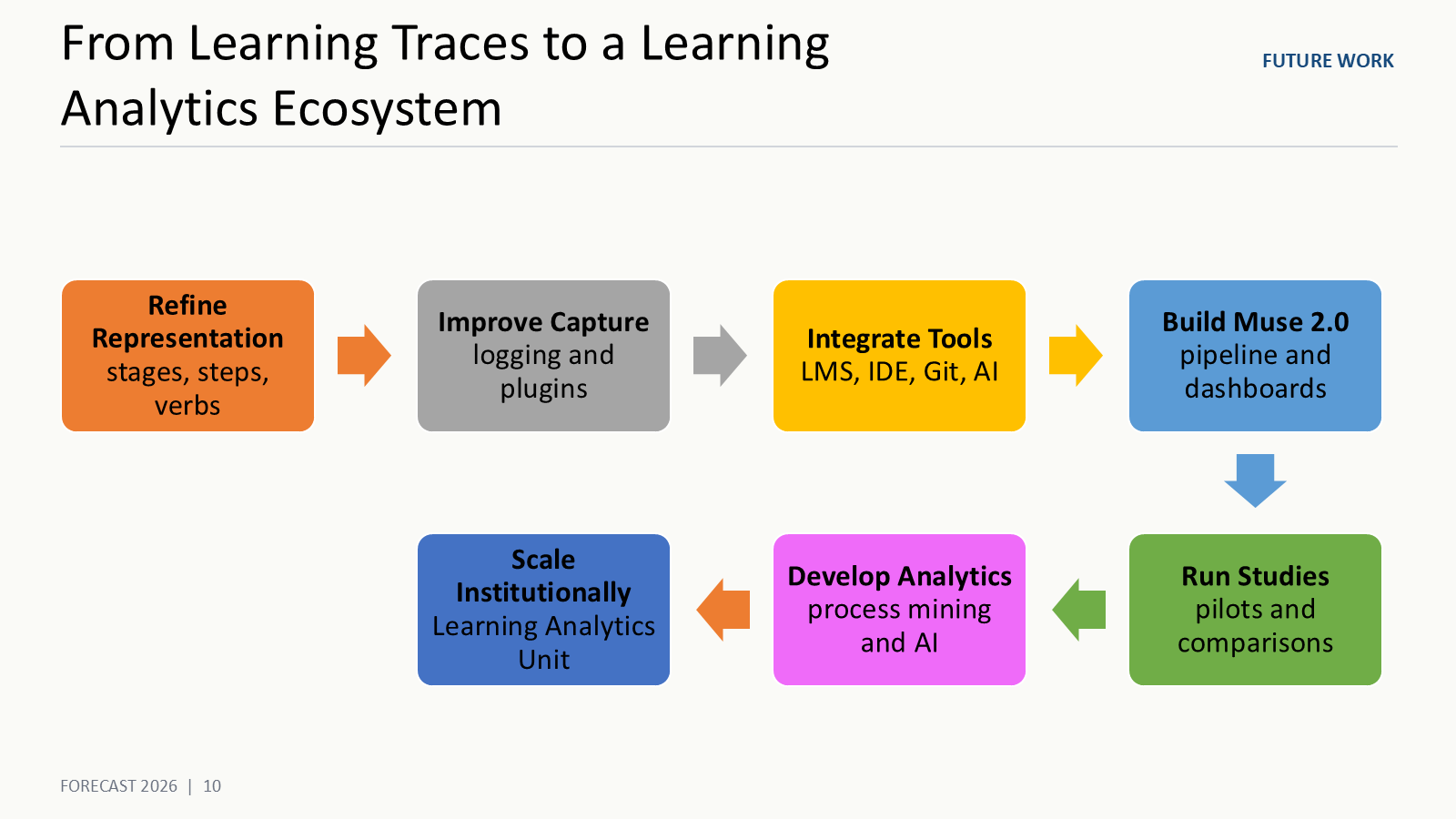
The roadmap connects four research areas. It extends toward tool integration, empirical studies, and a broader learning analytics ecosystem.
CaptureMeaningful activity from learning and development tools
RepresentStages, steps, actions, time, source, and context
AnalyseSequences and pathways, with process mining where appropriate
SupportLecturer judgement through visual analytics and summaries
A research roadmap. Later integrations and institutional infrastructure remain future directions.
FORECAST 2026 presentation
Explore the research roadmap.
Making Student Work Processes Visible. Browse all ten slides from the supplied presentation.
The slides preserve the presentation as supplied. Its roadmap includes future work; the current project and prototype status are described above.
Slide 1 of 10
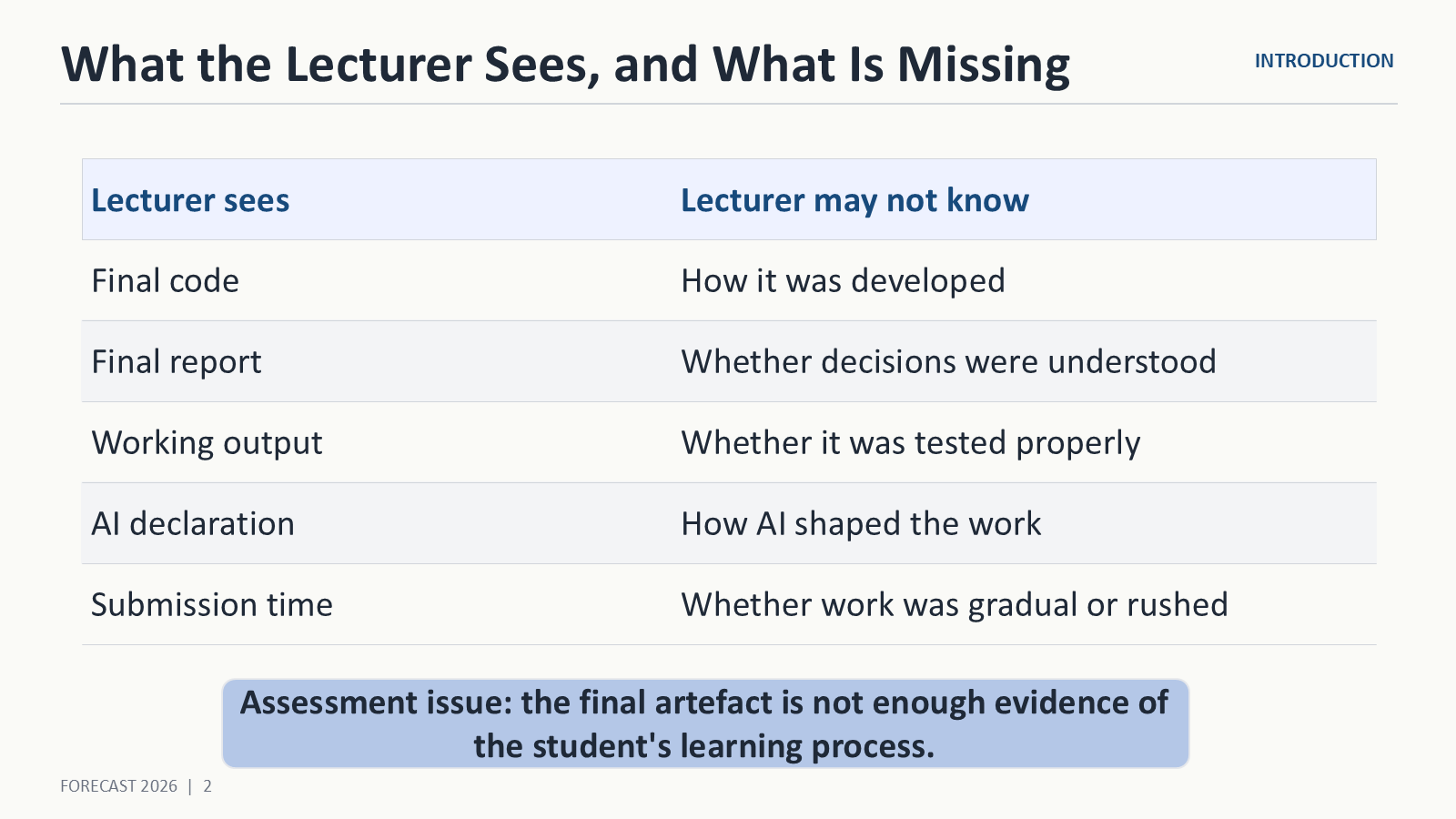
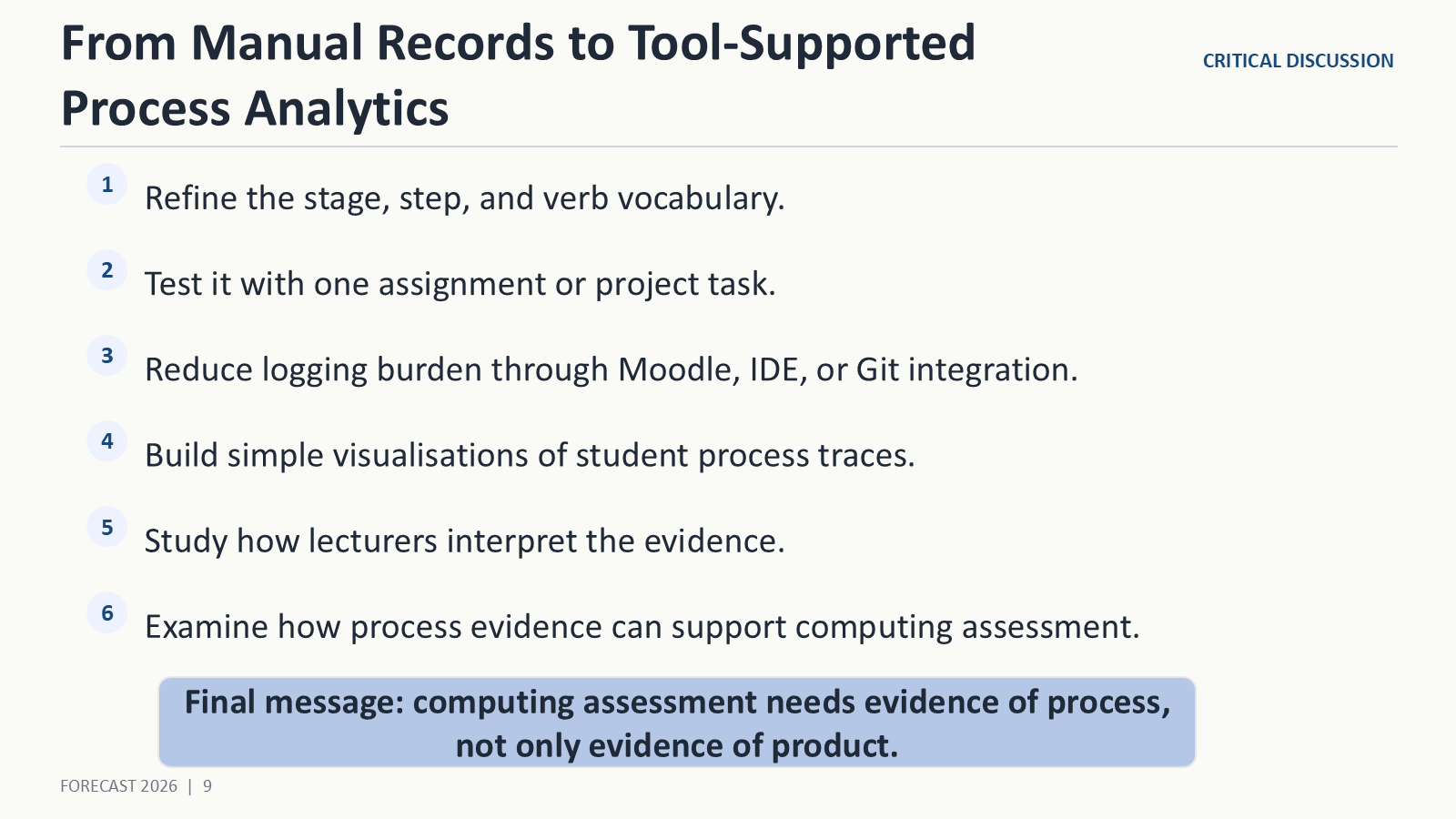
Slide 1 of 10 · Making Student Work Processes VisibleSlide 2 of 10 · What the Lecturer Sees, and What Is MissingSlide 3 of 10 · Example: A Programming AssignmentSlide 4 of 10 · What We Already Started:Slide 5 of 10 · Turning Raw Activity into Meaningful Process DataSlide 6 of 10 · The Roadmap: Four Computing Research AreasSlide 7 of 10 · What the System Should Help Lecturers AskSlide 8 of 10 · What Makes This DifficultSlide 9 of 10 · From Manual Records to Tool-Supported Process AnalyticsSlide 10 of 10 · From Learning Traces to a Learning Analytics Ecosystem
Selected publications and research outputs
A connected body of work.
Selected recent and relevant work in creativity, learning processes, learning analytics, and learning technology.
Recent Work
Ragbir-Shripat, D. (2026). Beyond the Final Artifact: A Stage-Aware Framework for Process Evidence in AI-Influenced Computing Assessment. IEEE TALE 2026. Accepted short paper.
Ragbir-Shripat, D. (2026). Making Student Work Processes Visible: A Research Roadmap for Computing Assessment in the Generative AI Era. FORECAST 2026, The University of the West Indies, St. Augustine.
Ragbir-Shripat, D., & Mohan, P. (2024). Students’ creative process vs creative product: Improving student creativity via learning analytics. In Proceedings of the UWI Five Islands Annual Research Conference 2024, July 8-10, Antigua & Barbuda.
Creativity, Learning Processes and Learning Analytics
Ragbir, D., & Mohan, P. (2018). Teaching Creativity Skills Using Process-based Creativity Theories within a Social Network. Proceedings of the International Conference on e-Learning, e-Business, Enterprise Information Systems, and e-Government, 33-36.
Ragbir, D., & Mohan, P. (2014). A TEL System for Teaching and Supporting Creativity in Tertiary Students: Incorporating the Views of Experts. Interaction Design and Architecture(s) Journal, Special Issue on The Design of TEL with Evidence and Users.
Ragbir, D., & Mohan, P. (2013). Using Process-based Creativity Theories within a Social Network to Support Creativity in University Students. Accepted for ECTEL 2013 Workshop.
Ragbir, D., & Mohan, P. (2012). Using Social Networking and Virtual Reality to Harness Creativity in Students in E-learning Situations. Doctoral Consortium, 12th IEEE International Conference on Advanced Learning Technologies, Rome, Italy.
Earlier Learning Technology Research
Ragbir, D., & Mohan, P. (2010). The service integration framework: Integrating non-generic learning services into IMS LD. International Journal of Learning Technologies, 5(4), 401-414.
Ragbir, D., & Mohan, P. (2009). Design of an IMS LD Editor Using Non-IMS LD Concepts. In Proceedings of the Ninth IEEE International Conference on Advanced Learning Technologies, Riga, Latvia, 251-255.
Ragbir, D., & Mohan, P. (2009). Creating Reusable Lesson Plans for E-learning using the IMS Learning Design Specification. International Journal of Education and Development using Information and Communication Technologies, 5(4).
Ragbir, D., & Mohan, P. (2006). The Potential of IMS Learning Design in eLearning. In T. T. Kidd & H. Song (Eds.), Handbook of Research on Instructional Systems and Technology.
Ragbir, D., Mohammed, P., & Mohan, P. (2006). The Supporter Learning Service: Providing Dynamic Help during the Execution of a Learning Design. In Proceedings of World Conference on Educational Multimedia, Hypermedia and Telecommunications 2006, 2741-2748.
Ragbir, D., & Mohan, P. (2005). Extending the Learning Design Specification with Services. In Proceedings of World Conference on E-Learning in Corporate, Government, Healthcare, and Higher Education 2005, 2784-2792.
Selected Work in Progress
Ragbir-Shripat, D., & Mohan, P. Using Learning Analytics to Computationally Measure Students’ Creative Experiences in Guided Creativity Learning Designs.
Ragbir-Shripat, D., & Mohan, P. A Learning Technology Framework for Modelling, Teaching, and Assessing Creativity.
About the researcher
Diana Ragbir-Shripat, PhD
Computing education, learning analytics, and computational representation of learning processes.
I am a computing educator and researcher in the Department of Computing and Information Technology at The University of the West Indies, St. Augustine.
My research investigates how learning processes can be represented computationally, validated, and connected to captured activity within an assessment's pedagogical design. A central direction is to support assessment of process and product together in the generative AI era.
Start a conversation
What could we investigate together?
I welcome discussions about ontology validation, assessment configuration, authentic process-data pilots, and intended versus enacted learning processes.